CALLY TRENCH
Art History Talks
Artists and Fisher Folk in Staithes:
Harold Knight's The Storm (c1897-1900)
Cally Trench: Art History Talks
|
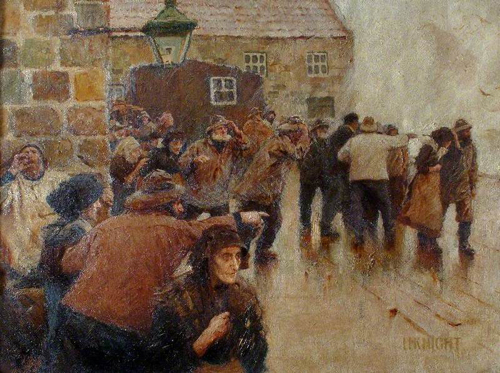
This painting by Harold Knight (1874-1961), husband of the much more famous Dame Laura Knight, was painted in Staithes, a small fishing village on the coast of North Yorkshire, which became home to around forty artists in the late 19th and early 20th centuries. It is a dramatic and atmospheric picture, which shows about twenty people on the quay at Staithes during a storm. There is a suggestion of waves or sea spray coming over the edge of the quay (top right). The wooden planks of the quay are wet, and the air is full of rain. The people are all fisher folk; the men are dressed in fishermen's hats, with oiled sou'wester jackets, and the women wear aprons and the unique Staithes bonnets. The limited palette of brown, white and dark blue creates a sense of a gloomy day, but also of a coherent group, at one with its surroundings: the sou'westers and aprons match the stonework of the buildings. Two men hold onto their hats, and several lean forward, revealing the power of the wind. Most of the people are looking out to sea, and two of the men are pointing. We understand that they are all waiting with anxiety for a boat to return. Some of the power of this painting lies in its asymmetry, the almost awkward composition. We do not see what the people are gazing at; we only see them, their postures and their expressions, and from these we can judge the seriousness of the situation. No one looks back at us; we are observers not participants in this drama. The painting is signed by Harold Knight in block capitals (bottom right): H.KNIGHT. Interestingly, the picture was painted on a patterned damask table cloth - which may indicate that he was too short of money to buy canvas at the time. Harold Knight Harold Knight was the second son of a successful Nottingham architect, William Knight, whose practice included a number of churches. Harold enrolled at Nottingham School of Art at the age of fourteen in 1888. Laura Johnson, who later became his wife (Laura Knight) describes in her 1936 autobiography Oil Paint and Grease Paint how: 'The student there for whom everyone predicted a great future was Harold Knight, a pale, black-haired young man.' Harold painted a portrait of Laura in 1891 when he was only seventeen and Laura was fourteen, not long after they met at the School of Art; this work is now in the collection of the Royal Academy of Arts. Harold made a series of studies and oil paintings of nude male figures, which won him prizes at the School of Art. He also won a British Institute Travelling Scholarship of 50 pounds a year for two years, and spent the second year studying at the Académie Julian in Paris. Provenance of The Storm While Harold was away in Paris, one of Laura Johnson's pupils, called Rosie Good, became a friend. She worked at Laura's studio and shared the cost of a model, and often spent the night there. It was Rosie Good's nephew, her sister's son - Eustace Alliott - that, with his wife, gave the painting to Wycombe Museum in 1951. Ten years later, in 1961, Mr Alliott wrote the Museum a letter explaining that: 'Rosie Good, was a fellow student with her [that is Laura] at the Nottingham Art School, and my mother and her family took a benevolent interest in the young and struggling painter, as yet unrecognised, and also in Harold Knight - whence the origin or possession of these paintings. Both my parents and grandparents were Nottingham people - my father being Chairman of an important engineering firm there.' The address on Mr Alliott's letter is Amersham, which may explain the donation to Wycombe Museum. Visiting Staithes Laura's sister Sissie fell ill, and a stay at the seaside was recommended. One of the teachers at Nottingham School of Art, Thomas Barrett, suggested Staithes as a good place to paint. And so, in the summer of 1897, Harold, Laura, Sissie, Rosie Good, and Laura's Aunt West went to Staithes, initially for a month's holiday. Harold was 23 and Laura was 19. Harold stayed on in Staithes after the first month, supported financially by his father, while the girls returned to Nottingham. Laura and Sissie soon sold up in Nottingham and moved back with Rosie Good to Staithes in 1898. Staithes as an artists' colony When Harold Knight and Laura Johnson arrived in Staithes in 1897, the fishing village had a well-established group of artists in residence or making regular visits, for whom the villagers acted as models. Laura explains that:'Staithes was used to painters, people were used to posing if they had time and you had money to pay for it.' Staithes was at its heyday as an artists' colony for about fifteen years, from 1894 to 1909, and there were at that time around forty members of the Staithes Group of Artists, who were nicknamed the 'Northern Impressionists'. However, these were no provincial artists; eleven, including Harold Knight, had studied in Paris at the Académie Julian, and others had studied or worked in Belgium or Holland. The Staithes Group of Artists was founded formally in 1901, with both Harold and Laura among the founding members. It held annual exhibitions until 1906; three were held in the Fishermen's Institute in Staithes, and the next three were held at galleries in Whitby. At the same time, many of the artists submitted work each year to the Royal Academy Summer Exhibition, which was then an important step towards recognition and sales. After 1906, the Staithes group was integrated into the Yorkshire Union of Artists and no longer held separate exhibitions. Staithes and the fishing industry Staithes had a prosperous fishing industry in the 18th and 19th centuries. The main catch was herring, but Staithes fishermen also fished for cod far out into the North Sea, and nearer home for crab and lobster. It was a dangerous way of life and fishermen wore ganseys - that is woollen sweaters - of patterns unique to their village, and also had their clothes initialled, so that their bodies could be identified. The anxiety depicted in The Storm was a real phenomenon. By the late 19th century, the fishing industry was somewhat in decline, was due to competition from trawlers from elsewhere, but in the 1890s a good number of smacks and cobles (small open clinker-built boats, with oars and sails, flat bottoms and high bows) still operated from Staithes. Harold Knight's painting Launching Cobles (probably 1902) shows the boats being pulled into the sea on their flat bottoms over greased logs. Cobles could also be secured by being tied to the wooden trestle bridge that crossed the beck (stream); Harold Knight's painting Herring Boats coming out of the Beck shows the cobles being launched on the outgoing tide. Limpets or mussels collected along the shore line by the fisherwomen were used as bait. Artists and fisher folk Gallerist Peter Haworth argues that: 'the artists had been accepted by the fisherfolk of Staithes and absorbed into the fabric of the village.' He adds: 'It was an unlikely partnership cemented by mutual respect.' This integration may have been especially true of the artists that lived in Staithes permanently, and who stayed in the long term. However, any account of the relationship between artists and fisherfolk is usually from the point of view of the artists - especially Laura Knight, whose 1936 autobiography is a major source of information. Art historian Laura Newton warns that: 'these retrospective accounts must be treated with a certain degree of caution' and that they have become 'part of the "mythology" surrounding the colony phenomenon'. The Last Coble It is interesting to compare Harold Knight's The Storm with his painting The Last Coble (1900), which is in the collection of Nottingham City Museums & Galleries. The Last Coble is thematically and compositionally somewhat similar to The Storm, with fisherfolk gazing out to sea, waiting in bad weather. It has a similar kind of asymmetry to The Storm, with the focus on the watchers rather than on what they are watching. As with The Storm, we see people pointing and holding onto their hats. The man in the middle distance at the centre of The Last Coble wearing a whitish jacket or gansey is almost a mirror image of the pointing man in The Storm who stands with his back to us in the cluster on the right. Similarly, the man with the white beard in the centre of The Storm is almost a mirror image of the man holding onto his hat in the foreground on the right of The Last Coble. The presence of these repeated figures suggests that these two oil paintings were not painted directly from life, but were constructed from sketches in the studio. The similarities are such that we might also expect the two paintings to have been painted around the same time. Dating The Storm Harold Knight's paintings of Staithes are difficult to date. We know that he was in Staithes from 1897 to 1907, and that he focussed more on interiors after 1903. There are occasional records of paintings in exhibitions, but for the most part dates are unknown. Laura Knight comments that, after her return to Nottingham following their first stay in Staithes, leaving Harold there: 'Letters came telling of big pictures that Harold was painting, that he had broken away from Art School influences'. So, it is possible that The Storm was one such painting, and dates back to 1897. I have therefore assigned a tentative date for The Storm of c1897-1900, between the date Harold first went to Staithes and the date of The Last Coble. 1903 and after In 1903, Harold and Laura got married, on the basis of Harold having portrait commissions in Nottingham and the sale of a painting of Laura's at the Royal Academy. During their honeymoon, they travelled to London and saw an exhibition of contemporary Dutch art. The following year, they visited the Netherlands, including Amsterdam, where they were excited by the paintings in the Rijksmuseum by Vermeer of women in interiors. Laura and Harold also visited the artists' colony at Laren, where they focussed on painting interiors, which they continued to do back in Staithes. They returned to Laren for six months in 1904, and for an entire year in 1905-1906. In 1906, they had successful Royal Academy pictures and a first joint exhibition at a significant London commercial gallery, the Leicester Galleries. In 1907, the Staithes Group largely disbanded; a few artists stayed in Staithes, but others moved away. The Knights' decision to leave Staithes is described by Laura Knight as follows: 'We could not contemplate another lonely winter and more tragedies, we were tired of wet and cold; a longing for the warmth and light that we had been assured were in Cornwall came over us.' The Knights left Staithes and moved to Newlyn in Cornwall, where they joined the artists' colony there. Laura Knight Laura Knight produced very little work that she was happy with while she was in Staithes; it was a time when she was trying things out and finding her own voice. But what she took with her when she left was the willingness to embed herself in communities to which she didn't naturally belong, to make friends and engage enthusiastically in the lives of close and often closed communities - circus people, Roma, and ballet dancers. These are the paintings that made her famous, and they reveal the same approach as her paintings of the people of Staithes - a thorough observation and engagement with people's everyday lives. She was elected an Associate of the Royal Academy in 1927, only the second woman to be so, and was made a Dame in 1929. She was elected to full membership of the Royal Academy in 1936, the first woman since the RA was founded (with two women founder members) in 1769. During the Second World War, she was an Official War Artist, including painting at the Nuremberg Trials. She was the first woman artist to have a solo exhibition at the RA - in 1965. She died in 1970 at the age of 92. Harold Knight Harold Knight produced many impressive and atmospheric paintings while in Staithes, but moved later towards a much quieter and more private approach to art - painting mostly portraits, either to commission or of paid models or friends, many of whom are engaged in reading or private thought Harold Knight was made a full member of the Royal Academy in 1937. He died in 1961, at the age of 87. Conclusion The Storm is a painting that is typical of Harold Knight's work in Staithes; we feel the drama, atmosphere and anxiety occasioned by the storm. It is a powerful and slightly uncomfortable work, and Wycombe Museum is lucky to own it. Laura Knight comments in her second autobiography, The Magic of a Line, written in 1965: 'The power latent in Harold's brush found food for expression in the wealth of material obtained by living in close companionship with the salt-water folk, whose toil is great and whose recompense is small. I wish today that I could have assurance that certain canvases of Harold's painted in those early days, have survived ... the misfortunes brought by two world wars.' If she were alive today, Wycombe Museum would be able to assure her that this particular example is on display and much appreciated. Cally Trench, October 2025 This is a summary of Artists and Fisher Folk in Staithes: Harold Knight's 'The Storm', an illlustrated Art Collection talk given by Cally Trench at Wycombe Museum on 24th July 2025, 19th October 2025 and 27th January 2026, and to the South Bucks U3A Discovering Art study group at Rossetti Hall, Holmer Green, on 11th March 2026. BibliographyColin Bullamore, They came: they saw: they created ... The Staithes Group of Artists 1894-1909 (2014).Peter Haworth, Paintings by Members of the Staithes Group exhibition catalogue (2002).Laura Knight, Oil Paint and Grease Paint (1936).Laura Knight, The Magic of a Line London (1965).Barbara C. Morden, Laura Knight: A Life (2014).Laura Newton, 'Staithes "Outside of the World"', in Laura Newton (Ed), Painting at the Edge (2005). |