ROGER PERKINS
Chapter Cabinets
|
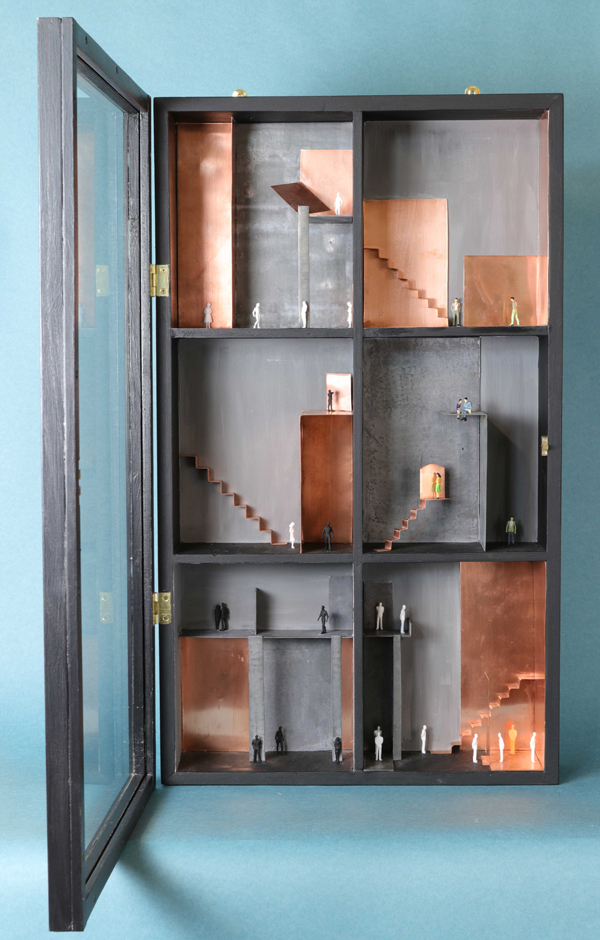
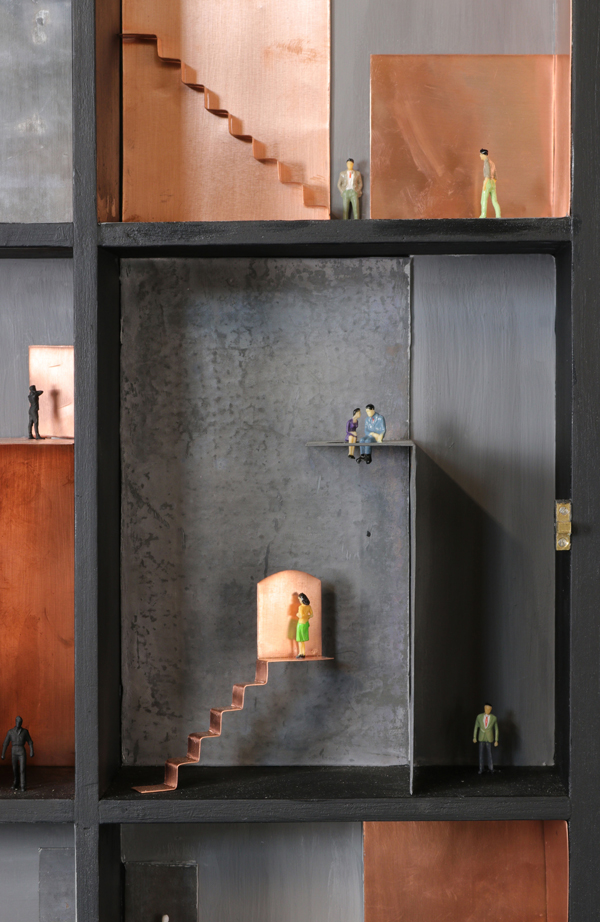
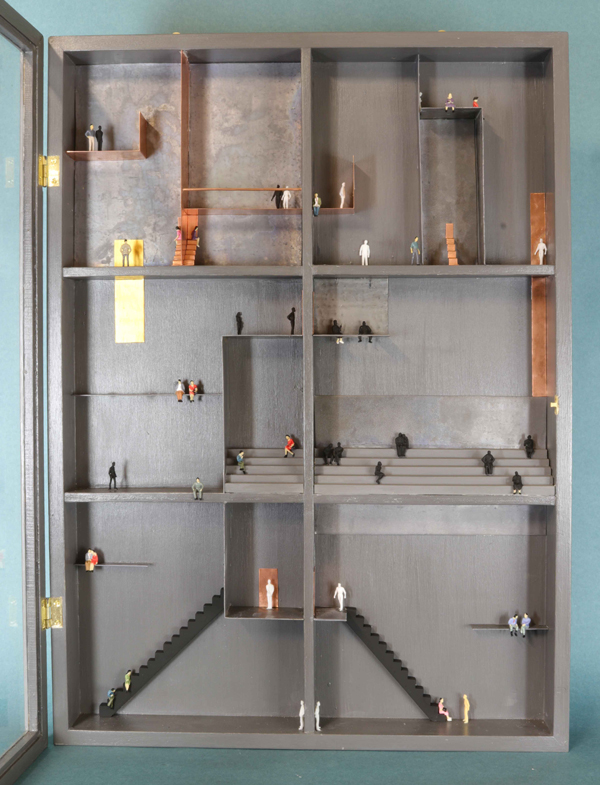
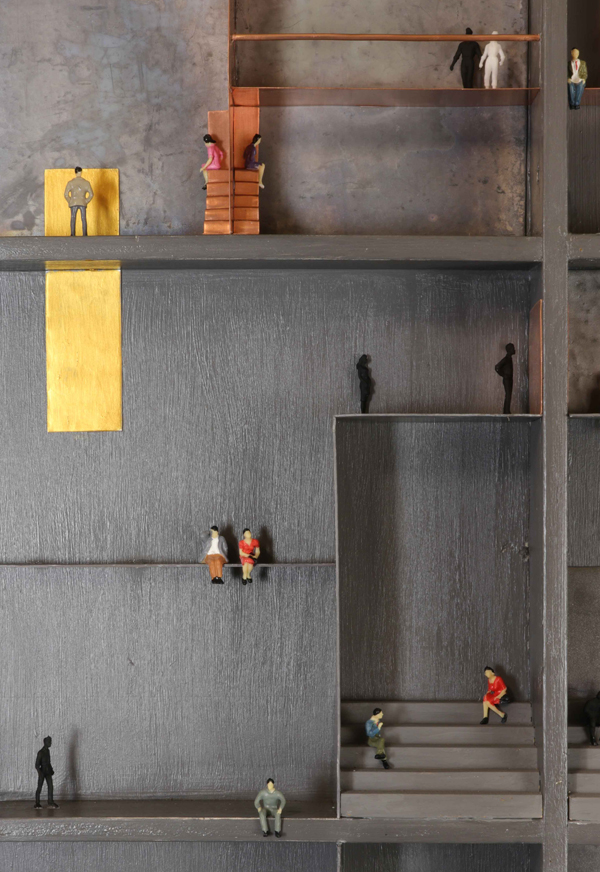
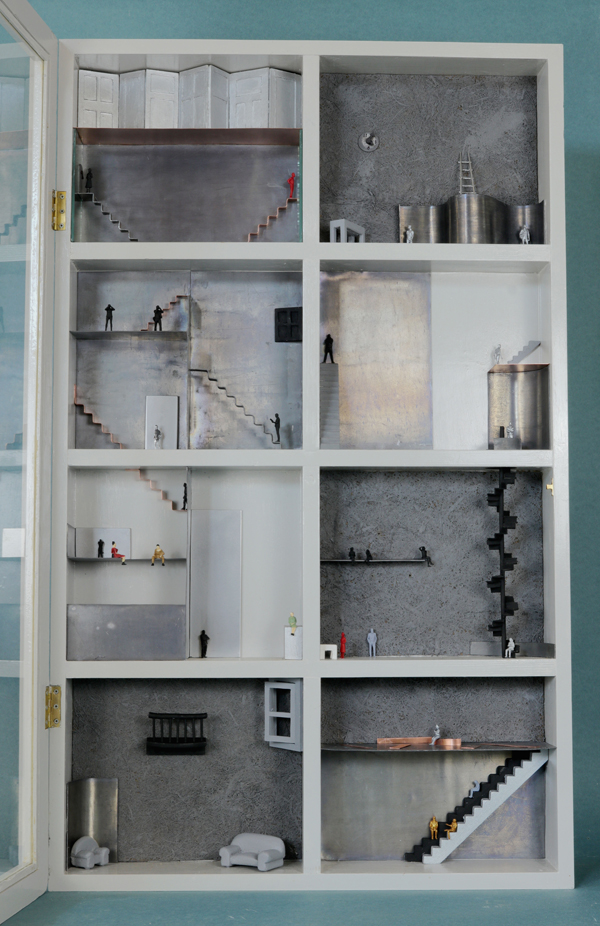
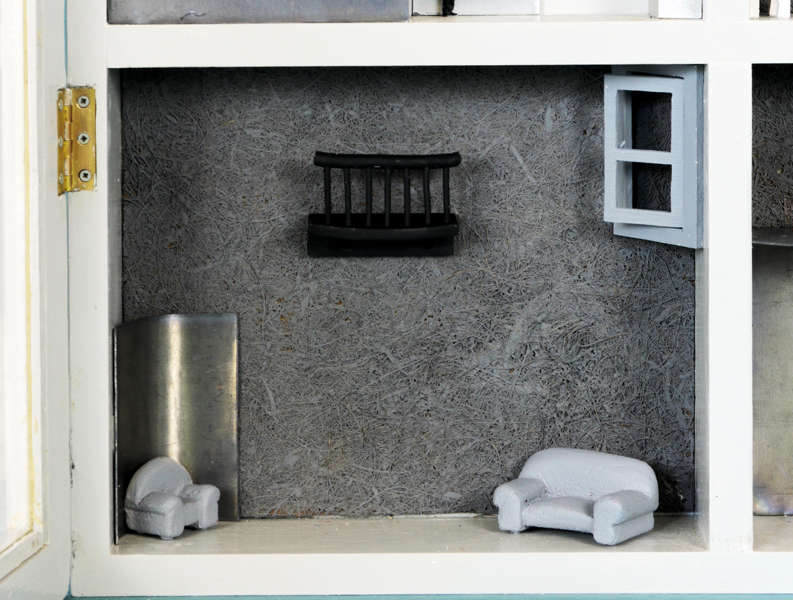
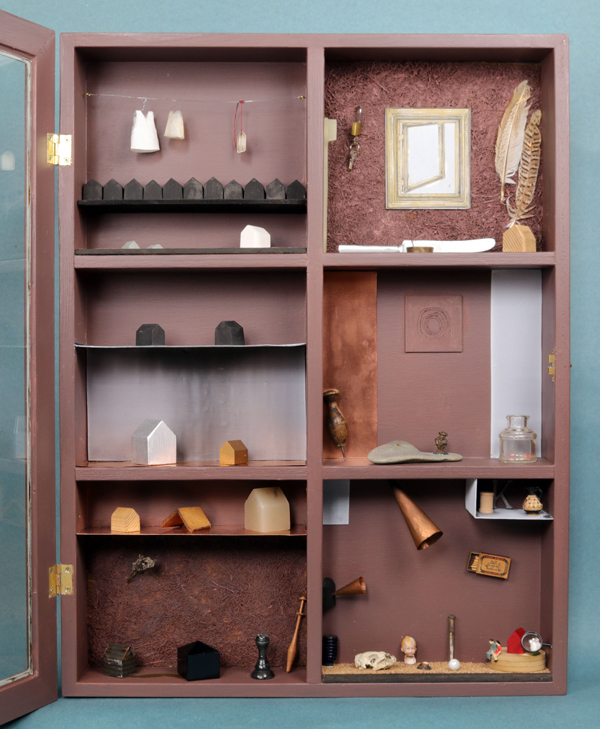
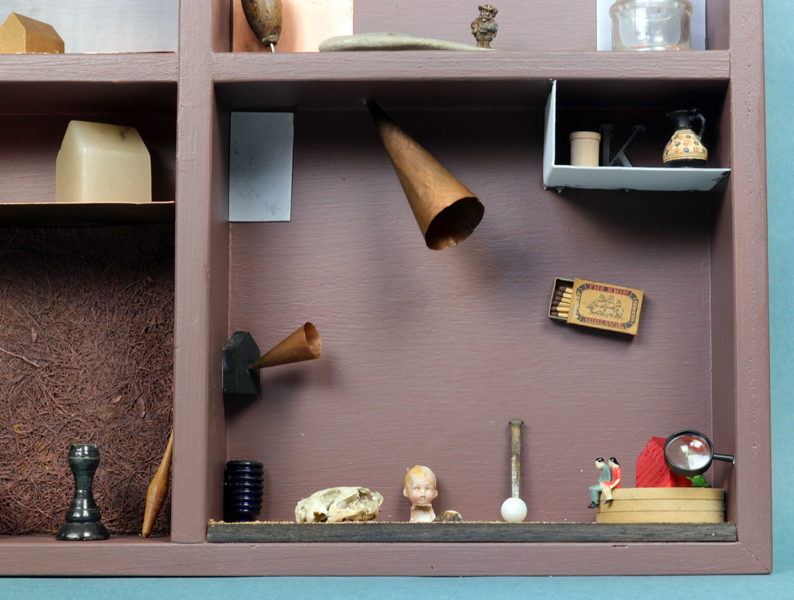
Cabinets of Curiosity, or Wonder-Rooms, were collections of rare and remarkable objects, both natural and fabricated, to amaze and please the viewer. Roger Perkins's beautifully-made Chapter Cabinets give us a god-like vista of an array of rooms, allowing us to spy on the tiny plastic people as they sit, stand and interact in spaces that are both familiar and strange. We recognise the architecture of staircases, ladders and balconies, the hint of art deco glamour in the copper walls, and the occasional chair, window and clock, but the geography makes no sense; staircases lead nowhere or fail to connect, leaving people stranded, isolated and endangered. The people themselves - often men in jacket and tie and women in dresses - seem to belong to an earlier era, adding to our sense of puzzlement. Each room invites us to create a miniature narrative, filtered through our own sense of what home means. |
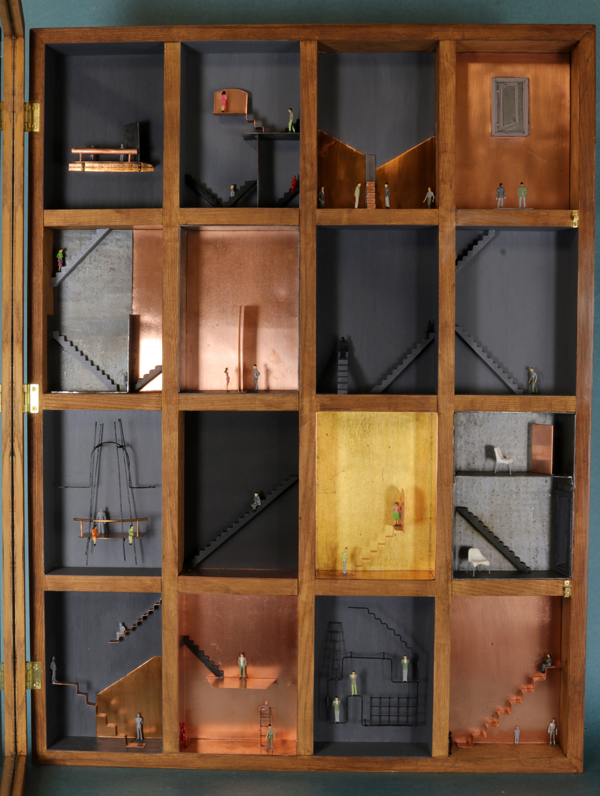
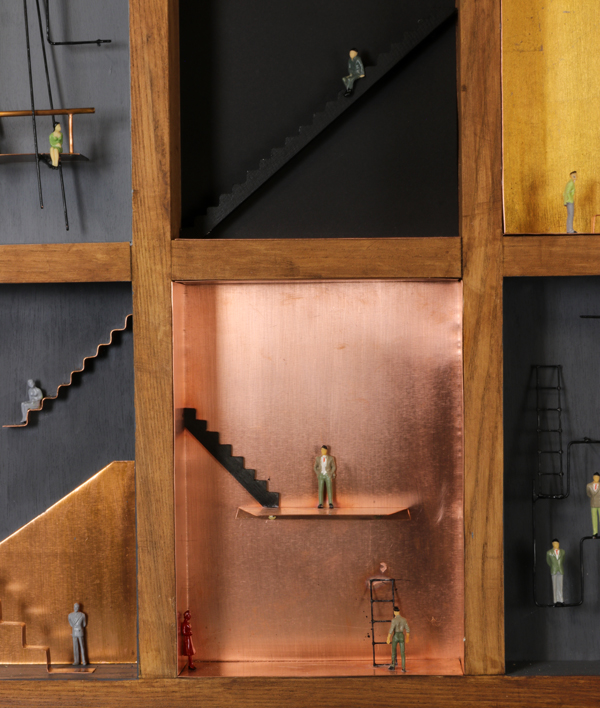
|
'Home is where the heart is.' The cliché is given a fundamental twist in the work of Roger Perkins. Home as a universal concept, a habitat of objects and dynamics, a focus of individuation and sentiment, and an ethical and aesthetic constraint is returned to obsessively in his work to date. The result is a powerful, sometimes aggressive, but always controlled series of statements, questions, some acting as commentary, others more personally involved of the affective and artistic consequences of placing one's heart in the 'home'. (Professor Sean Hand) |
|
Roger Perkins: 'I have lived in 25 different locations since I was born. I say 'locations' as many of these places were not in any way connected to what we would commonly refer to as 'home'. There is far more to home than simply a structure within which we shelter. Home needs associations - with objects (and their own associations), people (intimate and otherwise) and our relationships to memory.' We all feel compelling emotions in relation our homes, past and present, feelings conveyed well by the German word Heimat. There is no direct equivalent in English, but it means a sense of place, a sense of belonging and a sense of knowing/belonging to a place. It also encompasses a sense of cultural identity, emotional attachment and social community. Yet, though highly desirable and instinctively needed, 'home' is an elusive and mutable condition - especially at a time when modern life is often transient and changeable. But, home is what we strive for; it stabilises us, by giving us a sense of place and a sense of belonging. Even though our homes may be transient, subject to natural disaster, social change, and personal circumstances, we cling to the idea of home as central to our lives and needs. To be homeless is emotionally as well as physically distressing. |
|
We recognize even the barest symbols of a home, in the same way that we recognize the simplest representation of a human face. Just as children imbue dolls' houses and their occupants with emotions and narratives, Roger Perkins's curious rooms and miniscule people create powerful feelings in us and generate the urge to makes stories. The micro scenarios, each within a room where things happen, are separated by walls and floors - but all are held under one roof. |
|
Roger Perkins has been a sculptor for over forty years and has exhibited in the UK, Europe and the US. Originally studying both ceramics and sculpture at Camberwell School of Arts and Crafts, he pursued ceramics for a number of years before turning to non-clay 3D work in a multitude of materials - from wax and wood to video projections. His work is in a number of public museums, including Leicester Museum & Art Gallery, the Contemporary Art Society, Paisley Museum and Art Galleries, and Discover Bucks Museum, as well as private collections, and he has received a number of awards and grants (including from the Arts Council, the Esmée Fairbairn Foundation, and the Pollock-Krasner Foundation) towards projects in the UK and abroad. Alongside his professional practice, Roger has taught art and design at foundation, degree and post-graduate levels, and is currently joint leader of the Warehouse Art School in Oxford. |