CALLY TRENCH
Art History Talks
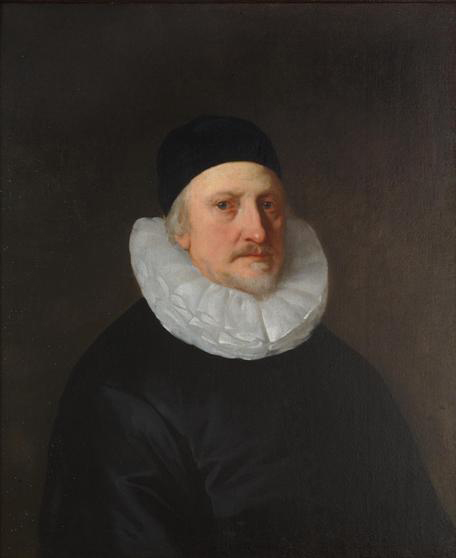
Portrait of Moses Tryon (c1646)
attributed to Peter Lely
Cally Trench: Art History Talks
|
This is one of the most important paintings in the Museum's art collection, attributed to Peter Lely. The modelling and shadows on Moses Tryon's face are delicate and subtle, and we get a strong sense of his serious character. He is dressed in black, with a beautifully-painted white ruff. In the 17th century, clothing could indicate both status and religion. Protestants tended to wear plainer and simpler clothes, and we can see from his clothing that Moses Tryon was a Protestant. Moses Tryon Moses Tryon was a merchant of Dutch descent. His father, Peter Tryon (c1540-1611), was a Protestant in the Netherlands, which, at that time, was part of the Holy Roman Empire. When Protestantism spread in the north of the Netherlands in the 16th century, the Emperor Charles V reacted by banning it in 1521 and establishing an Inquisitor in 1523 to pursue 'heretics'. During the reign of Charles V's son, Philip II, the Inquisitor Pieter Titelmans was appointed; he was infamous for the number of trials and executions of Protestants. Philip II was also the Philip of Spain that was married to the English Queen Mary Tudor, the oldest child of Henry VIII, and a Catholic. When Queen Mary died in 1558, her half-sister Elizabeth became Queen. She was a Protestant, so at this point England became a safe place for Protestant refugees, including Peter Tryon, who arrived in London with his wife Claes about 1559. Peter and Claes Tryon had children in England. After Claes died, Peter married again - Mary - and had more children, including Moses, the man in the portrait. Moses was baptized in the Dutch Church in London on 21st December 1572. In 1600, at the age of about 28, he married Sara van der Peele, and they had at least nine children. He became the heir of both his older brother Abraham and his father, and by 1617 he was being described as 'a merchant of London'. Moses bought and lived in the manor house at Harringworth in Northamptonshire. He was buried in the parish church at Harringworth, where he had a family vault built. Provenance The painting was passed down the generations to Miss Eliza and Miss Ellen Harman, the daughters of a well-known High Wycombe solicitor, and they donated the painting to Wycombe Museum in 1932. The frame The portrait was intended for an oval-aperture frame, and the plain background in the corners would not have been visible. In fact, when Wycombe Museum was first given the painting, it was in an oval aperture frame - but of the 18th century, so this cannot have been the first frame. That frame was in bad condition, and a decision was made to commission a new frame in 1992. The new frame is very much in keeping with the sobriety of the painting itself. Attribution to Anthony van Dyck When the portrait of Moses Tryon was given to Wycombe Museum, it was believed to be by the great portrait painter Anthony van Dyck (1599-1641). This is possible in terms of dates and style. Van Dyck also came to England from the Netherlands, but not to flee religious persecution; he was a devout Catholic. As a young man, van Dyck studied in the workshop of Peter Paul Rubens, and he also spent about five years mostly in Italy studying the work of artists such as Titian. In 1632, Anthony van Dyck, then aged 33, accepted an invitation from King Charles I to come to England. He was knighted that year, given the title 'Principal Painter in Ordinary to their Majesties', and awarded an annual pension. Van Dyck died in 1641, so it is not impossible in terms of dates that van Dyck painted the portrait of Moses Tryon between 1632 when he settled in England and his death in 1641, but perhaps unlikely given that van Dyck was a court painter and Moses Tryon was a merchant. Attribution to Peter Lely The attribution of the portrait of Moses Tryon to a different artist - Peter Lely - was first made by the art historian Sir Oliver Millar (1923-2007). Millar studied at the Courtauld Institute in London, and then worked with the Royal Collection for 41 years from 1947, becoming Surveyor of The Queen's Pictures from 1972 to 1988. Millar was an expert on 17th century British painting, and he published books, catalogues and articles on, amongst others, Peter Lely and Anthony van Dyck. Millar lived near High Wycombe, and visited the Museum on a number of occasions. In a 1991 letter, he says: 'This is a good example of the early work of Lely and probably painted in London, c.1646.' This would make Moses Tryon aged about 74 in the portrait. Peter Lely (1618-1680) Peter Lely was born in 1618 in Westphalia, a part of Saxony, in present-day Germany, to Dutch parents. He was accepted into the painters' guild, the Guild of St Luke, in 1637, and came to England about seven years later, in around 1643, at the age of about 25. Initially Lely's paintings were of mythological and biblical scenes, but it was his portraits that were sought-after. It was Sir Oliver Millar's belief that the portrait of Moses Tryon was painted in these early years in England - about three years after Lely arrived here. Lely succeeded Anthony van Dyck as the most fashionable portrait painter in England, a position that he managed to keep despite the political changes brought about by the English Civil War. He painted both King Charles I and Oliver Cromwell. After the Restoration of the Monarchy, King Charles II appointed Lely to be his Principal Painter in Ordinary in 1661, with the same title and pension as Anthony van Dyck had received from Charles I - and he knighted Peter Lely in 1679, the year before Lely died - in 1680. Conclusion This 17th-century beautiful portrait of a merchant demonstrates the skill of the artist, Peter Lely, and the shows us the character of the sitter, Moses Tryon. It is one of the greatest treasures of Wycombe Museum. Cally Trench, August 2025 This is a summary of half of Lely or not Lely: 'Moses Tryon' and 'Lord Wharton and family', an illustrated Art Collection talk given by Cally Trench at Wycombe Museum on 12th May 2024 and 5th September 2024. |