CALLY TRENCH
Art History Talks
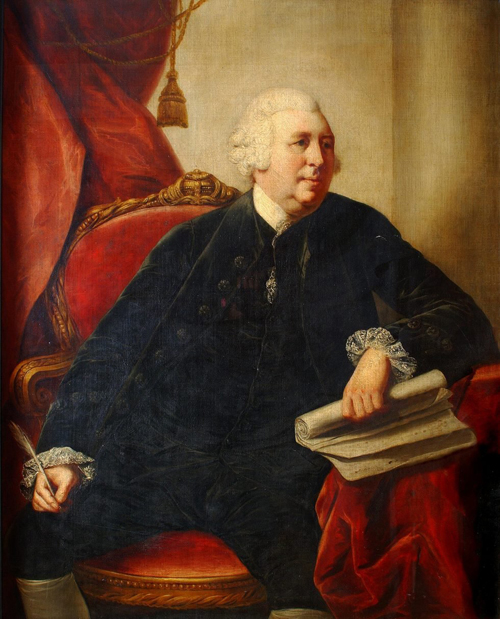
Portrait of Lord Shelburne
(1782) by Sir Joshua Reynolds
Cally Trench: Art History Talks
|
This is a portrait of Lord Shelburne, one of the UK's least-known Prime Ministers, by Sir Joshua Reynolds, one of the most famous British portrait painters of the 18th century. Lord Shelburne (1737-1805) had a connection with High Wycombe: he lived at Loakes Manor (now Wycombe Abbey School). He was briefly Prime Minister, in 1782 and 1783, and his greatest achievement was negotiating the terms of the Treaty of Paris, which ended the American War of Independence (American Revolutionary War). The treaty was signed on 3rd September 1783. In the portrait, Lord Shelburne has a quill in his right hand and a scroll in his left, and he is wearing a wig and a 'court suit' in dark blue velvet, with a waistcoat, knee breeches, and a jacket with distinctive long button-holes on the sleeves, white lace cuffs, and silk stockings. The painting is in one of Reynolds' standard sizes, known as a 'half-length', which is 50 by 40 inches. The painting was acquired by Wycombe Museum in 1938 from a firm of London art dealers, who had bought the painting ten years earlier from the Marquess of Lincolnshire (Charles Wynn-Carrington, Lord Carrington, whose grandfather had bought Loakes Manor from Lord Shelburne in 1798 and renamed it Wycombe Abbey). According to Graves and Cronin's 1899 A History of the Works of Sir Joshua Reynolds P.R.A., the painting was bought by Lord Carrington in December 1870 from Henry Graves & Co (art dealers), who had themselves bought it the previous month. There is no information about where it was before Henry Graves & Co bought it. Lord Shelburne Lord Shelburne was born William Fitzmaurice in Dublin in 1737, the older of two sons of John Fitzmaurice, a grandson of the Earl of Kerry. William spent his childhood in a rural area of southern Ireland, in County Kerry. In 1751, when William was 14, John Fitzmaurice's maternal uncle, Henry Petty, died, having outlived all his children. Henry Petty had been MP for High Wycombe from 1722 to 1727, and he had bought Loakes Manor in 1700. Confusingly, Henry Petty was also the Earl of Shelburne, but the title died with him - for the moment. There is a large and magnificent monument to Henry Petty in All Saints' Church, High Wycombe, by Peter Scheemakers, erected in 1754. It shows Henry Petty and his wife, dressed in Roman style in togas and sandals, surrounded by their children. When Henry Petty died in 1751, his nephew John Fitzmaurice - William's father - inherited the Petty estates, including Loakes Manor, and took the surname Petty. William also changed his surname to Petty. Two years later, in 1753, William's father – now John Petty - was made the Earl of Shelburne in the Irish peerage, uncle Henry's title being revived for him. From 1754 to 1760, John Petty was MP for Wycombe. (He could sit in the House of Commons because his title was in the Irish, not the English, peerage.) In 1754, John Petty bought an estate in Wiltshire - Bowood - which became his main residence. He had the house there extended by the architect Henry Keene, and the grounds redesigned by Lancelot 'Capability' Brown. He used the same architect to extend Loakes Manor, and in 1757, he also commissioned Keene to design the Guildhall in High Wycombe. William was briefly a student at Christ Church College, Oxford, and then in 1757 he joined the army and fought in the Seven Years' War under General Wolfe, seeing action. William ended up as aide-de-camp to King George III with the rank of colonel. In 1760, William's father - John Petty - was created Lord Wycombe, Baron of Chepping Wycombe, in the English peerage. This meant he could now sit in the House of Lords. So, his seat in the Commons was empty, and William, while still abroad and in the army, was elected MP for Wycombe (at the age of 23) in his father's place. However, he never took his seat in the House of Commons. His father died in 1761, and William succeeded him as the Earl of Shelburne (and as Baron Wycombe), and moved to the House of Lords at the age of 24. He was called by his Irish title - Lord Shelburne - as a courtesy. In the same year, 1761, the new Lord Shelburne persuaded the Wycombe town authorities to move the old road, which was where the Dyke is now, further from his house to its current position (the London Road). Horsenden Road, now Queen Victoria Road, was leased from the authorities to be the carriage drive, and Marlow Road was moved to the west of the house, to its current position, instead of running through the Loakes Manor park. The Dyke was created as part of the garden design work, probably by Capability Brown. Thomas Langley's The history and antiquities of the hundred of Desborough, and deanery of Wycombe, in Buckinghamshire of 1797 notes that: 'The grounds and gardens have been improved with great taste ... formed a small stream into a beautiful sheet of water. The plantations are judiciously railed to exclude the town ...' In 1763, Lord Shelburne gained his first (short-lived) ministerial role - as First Lord of Trade. In 1765, Shelburne married Lady Sophia Carteret. They had two sons, John Henry Petty, who was born in December that year, and William, born in 1768, who died at the age of nine. The following year, when William Pitt 'the Elder' became Prime Minister, Lord Shelburne was appointed Southern Secretary. At that time, there were two departments that dealt with foreign affairs - the Southern and the Northern Departments, which covered the work later done by the Home and Foreign Offices. The Southern Department dealt with some aspects of home affairs, the colonies, and parts of southern Europe. So, as the Southern Secretary, Shelburne was responsible for dealings with the colonies, including the American colonies. Shelburne remained in that post for just over two years, from July 1766 to October 1768, first under Pitt, and then under Lord Grafton. However, Shelburne was dismissed from his position because the King didn't like his conciliatory approach to the Americans. When Lord North became Prime Minister in 1770, Lord Shelburne went into opposition along with Pitt for twelve years, until 1782. Lord Shelburne's wife, Sophia, died in 1771 at the age of 26, after only six years of marriage, and he commissioned the splendid memorial that can be seen in All Saints' Church, High Wycombe, by Agostini Carlini (1718-1790). The American War of Independence (American Revolutionary War) started in 1775. And in 1778, Britain was at war with France again - the Anglo-French War, or Bourbon War, which lasted until 1783. So, Britain was fighting two wars at the same time. Lord Shelburne married again in 1779, to Lady Louisa Fitzpatrick. They went on to have one son, Henry Petty-Fitzmaurice, and one daughter, Lady Louisa Fitzmaurice. In March 1782, the Prime Minister, Lord North, was forced out of office by a motion of no confidence, mainly because of his failure to win the wars against the Americans and the French. Lord Rockingham returned as Prime Minister, and Shelburne took office as the first ever Home Secretary. In July the same year, Rockingham died suddenly, and the King asked Lord Shelburne to become Prime Minister. Lord Shelburne's main achievement as Prime Minister was negotiating the terms of the Peace of Paris, which ended the war with the Americans. In this he was helped by his friendship with Benjamin Franklin. The Treaty was regarded by many in Britain as too generous, but Shelburne's belief was that good terms would lead to America becoming an important trading partner, and that free trade would lead to peace. In April 1783, Shelburne was compelled to resign as Prime Minster. He was made Marquess of Lansdowne in December 1784 and effectively retired from politics. In 1786, he and his wife retired to Bowood, leaving his son by his first wife, John Henry, living in Loakes Manor. Lord Shelburne continued to take an interest in the issues of the day. He conducted a huge correspondence, and commissioned reports. He collected books, maps and works of art, and he corresponded or conversed with many important thinkers of the day. In 1789, Shelburne sold Loakes Manor to Lord Carrington to help clear some of his substantial debts. In old age, Shelburne noted ruefully that he lost nearly 40,000 pounds by being bond for other men 'and all the return I had was treachery, and a great deal of unjust public abuse'. Lord Shelburne died in 1805 at the age of 68, and was buried in All Saints' Church in High Wycombe. No monument was erected. The only memorial to Lord Shelburne is a small stained-glass window in All Saints' Church, dating from 1990, which commemorates William Petty and Benjamin Franklin, and the foundation of the United States. Shelburne died with debts of £90,000, which in today's money equates to about ten million pounds. Almost everything he had collected was sold to pay his debts. The label on the portrait The label on the frame dates it 1782 and records Shelburne as being 'Secretary for Foreign Affairs', a position he never held. The label is inaccurate and clearly dates from later than the painting itself. In 1782, Shelburne was still in opposition until March, then Home Secretary from March to July, and then Prime Minister from July until March the following year, 1783. The scroll that Lord Shelburne is holding in the portrait is clearly an important document, probably the Treaty of Paris itself. If we see this painting as a celebration of his treaty, which was signed in 1783, a date of 1783 is more likely for the portrait, not 1782 as on the label. Other portraits of Lord Shelburne by Sir Joshua Reynolds Wycombe Museum's portrait was not the only one that Reynolds painted of Lord Shelburne. Reynolds first painted Lord Shelburne in 1766. This is a 'half-length' showing Shelburne in his lord's robes, with an ermine cloak over a fur-edged red robe, red breeches, a gold jacket, and a sword. In this portrait he is wearing his own hair, powdered. His sitting pose is a standard one for Reynolds, and there are many other portraits of men in a similar pose. Lord Shelburne's first wife, Sophia, wrote in her diary in July 1766: 'My Lord went with me to Reynolds where there is a very like picture of him.' Reynolds' standard charge for a 'half-length' at that time was 70 guineas (£73 10s). The National Portrait Gallery lists three versions of the painting - at Bowood (in Wiltshire), at Saltram (in Devon), and at Dalmeny (near Edinburgh). The National Portrait Gallery has in its own collection a copy of the head and shoulders of this 1766 painting. Reynolds painted Lord Shelburne again in c1775 in a similar pose to the 1766 portrait. Shelburne is wearing a court suit as he does in Wycombe Museum's portrait, and he is wearing his own hair, but powdered. This portrait in in the collection of the National Museum of the Arts in Cuba. Reynolds also painted a portrait of Lord Shelburne's second wife, Lady Louisa Fitzpatrick, Lady Lansdowne in 1786. Lord Shelburne is reported as saying: 'I have lived with some of my Reynoldses for thirty years or more, and have liked them better and better every day.' Sir Joshua Reynolds (1723-1792) Joshua Reynolds was born in 1723 in Plympton, Devon. In 1740, he became a pupil of Thomas Hudson, a famous London portrait painter. Reynolds stayed with Hudson for three years, and then returned to Devon, where he worked as a portrait painter in Plymouth. In 1749, when he was 26, Reynolds met Commodore Augustus Keppel, who invited him on a voyage on his ship, HMS Centurion, to the Mediterranean. This was followed by two years in Rome, where Reynolds studied the Old Masters and acquired a taste for the 'Grand Style', a European style which often involved visual metaphors and the depiction of both nature and people so that they represent an ideal. Reynolds returned to England in 1752, and established himself in London, where he stayed for the rest of his life. He was prolific, popular and successful. Some of his portraits were very much in the Grand Style, with costumes, dramatic poses, idealisation and wild landscapes. Reynolds was financially successful. For each portrait, he set the pose, and painted the head. His assistants painted the rest - hands, furniture, books, etc - apart from the clothes, which were painted by a specialist drapery painter. The sitter often left the clothes with the studio and they were modelled by an assistant for the drapery painter. The Earl of Bath commented in 1761: 'I have discovered a secret by being often at Mr Reynolds, that I fancy, he is sorry I should know. I find that none of these great painters finish any of their Pictures themselves.' Reynolds also experimented with materials, using media such as shellac, resins, non-drying oils, varnishes, waxes and bitumen as well as ordinary oil paint. It has been suggested by Alexandra Gent, writing in 2015 about technical analysis of Reynolds' paintings, that the main problem was the 'extensive layering, sometimes of incompatible materials' that led to cracking, rather than any one particular material. However, Wycombe Museum's portrait of Lord Shelburne shows no signs of cracking. Reynolds' pupil James Northcote noted that Reynolds 'kept a portfolio in his painting room containing every print that had been taken from his portraits; so that those who came to sit had his collection to look over, and if they fixed on any particular attitude, in preference, he would repeat it precisely in point of drapery and position; as this much facilitated the business, and was sure to please the sitter's fancy.' However, Wycombe Museum's portrait of Lord Shelburne is not a standard pose in the way that the earlier portraits of him by Reynolds were. The only other work of Reynolds that it resembles in terms of pose is an early portrait of Samuel Johnson, which was unfinished and never left the studio; an engraving of it was made in 1798, when it was wanted as the frontispiece for Boswell's Life of Johnson. Joshua Reynolds helped found the Royal Academy and became its first President in 1768. In 1789, he lost the sight in his left eye, and retired from painting. Over his working life, Reynolds painted over 2000 portraits. In 1790, the year after Reynolds gave up painting, his pocket books note that he met with Lord Shelburne on six occasions, suggesting that their social encounters continued into old age. Reynolds died in 1792 and was buried in St Paul's Cathedral. Conclusion This is an important portrait of a Prime Minister, Lord Shelburne, by one of the most popular, prolific and inventive British portrait painters, Sir Joshua Reynolds. It appears to commemorate a significant moment in British history - the Treaty of Paris, which ended the American War of Independence (American Revolutionary War). The connection that Lord Shelburne had with High Wycombe adds to the painting's considerable interest. This is a summary of Portrait of Lord Shelburne by Sir Joshua Reynolds, an illustrated Art Collection talk given by Cally Trench at Wycombe Museum on 3rd September 2023 and 7th September 2023. Notes(1) Edmond George Petty-Fitzmaurice, Life of William, Earl of Shelburne, Volume 2 Chapter X https://en.wikisource.org/wiki/
|