CALLY TRENCH
Art History Talks
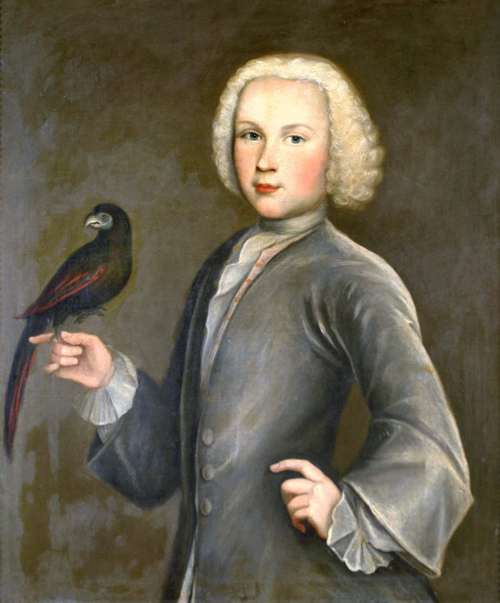
Portrait of Joseph Pettifer (1745)
by (school of) Joseph Highmore
Cally Trench: Art History Talks
|
This mid-18th century painting is of a young man holding a parrot. We know very little about the young man himself except what we can see in the painting and that he died at the age of 19 in 1748, which makes him about 16 in this painting. The painting was acquired by the Museum from a Mrs R.P. Lacey in 1937. The painting itself is about 30 x 25 inches, which was a standard 18th-century size, known as a 'bust' or 'three-quarters', because it required three-quarters of a yard of canvas, that is 27 inches, from a roll 32 inches wide. The extra inch all round was needed to attach the canvas to the stretcher. The painting depicts young Joseph Pettipher wearing a greyish-blue velvet jacket over a shirt with frilled cuffs, and a stock at his neck. He is wearing a wig, which was normal for wealthier men at the time. White was the most fashionable colour, with wigs being powdered. Children didn't usually wear wigs, so the fact that Joseph is wearing one is a sign not only of class but also of adulthood. Mayors of High Wycombe Joseph Pettifer belonged to a wealthy and powerful local family, some members of which had been mayors of High Wycombe, including, with some spelling variations, John Peytevyn (in 1391 and 1400), George Peytever (on eight occasions between 1525 and 1552), Matthew Pattypher (1633-34), and John Pettypher (1682-83). This was a matter of such pride that was inscribed on a monument to young Joseph's father, also Joseph, in All Saints' Church, High Wycombe, which is now almost indecipherable. Luckily, it was recorded in 1797, and reads as follows: 'Near this place lies interred the body of Joseph Peytever, alias Pettipher, gent. one of the aldermen of this borough, who departed this life the 11th day of June 1730, aged 50 years. It is remarkable that one or more of this name or family have served public offices in every king or queen's reign since the reign, of king Henry VI (except the short reign of Richard III) ; as appears by the ledger book belonging to the corporation. Left surviving one son, Joseph, who departed this life, Aug. 14, 1748, aged 19 years.' The reference at the end to 'one son, Joseph' - the young man in the portrait - must have been added 18 years after the rest of the inscription. The parrot In the painting, Joseph Pettifer is holding a black and red bird, which has a parrot head and beak. I have not been able to identify the species of parrot. It is possible that it is intended to be a Grey Parrot, which has a pale face and a red tail, although the tail in the painting is much longer and the plumage looks darker. Grey Parrots were available as pets and status symbols for the wealthy in the 18th century. Interestingly, Wycombe Museum has another parrot painting in its collection (but not on display); this is Lady with a Bird by an unknown artist (oil on canvas, H 69.1 x W 59.3 cm). It is a copy of a late 17th-century painting in oil on board by an earlier unknown artist. In this painting, the woman seems alarmed and surprised by the parrot. Parrots appear more often in portraits of women than men, because parrots were regarded as symbols of innocence and marital fidelity. A well-known painting by Peter Lely, Girl with a Parrot (c1670), which is in the collection of the Tate Gallery, shows a girl feeding cherries to a Grey Parrot. Cherries were also symbol of innocence, and the parrot may have had a double purpose - indicating both the wealth of the girl's family and her purity. Wycombe Museum's portrait of a young man with a parrot is therefore unusual - but it may be that Joseph really had a pet parrot, or that the parrot is being shown as a status symbol, along with the velvet coat and wig. Joseph Highmore (1692-1780) Joseph Highmore was born in London around 1692, the son of a coal merchant. Highmore began a legal training, but abandoned it in favour of art, and attended a drawing academy run by Godfrey Kneller, a very popular and prolific German artist, and a favourite of King Charles II. Highmore also attended anatomy classes. In the 1730s, he visited the Netherlands to study the work of Peter Paul Rubens and the Antony van Dyck. He also visited Paris to study work in collections there. A self-portrait of 1745-47 by Joseph Highmore is in the collection of the National Gallery of Victoria, Australia. One genre that Highmore favoured was the 'conversation piece', in which a group of people are portrayed as chatting to each other, or being sociable. They differ from group portraits in that there are clear interactions between the sitters, and they are posed to talk to each other rather than stare out at us. A particularly interesting conversation piece by Joseph Highmore is Mr Oldham and his Guests (1735-45), which is in the collection of the Tate Gallery. This painting shows Mr Oldham arriving to find that his three guests have made themselves at home in his house with a pipe and a bowl of negus (a hot spiced wine drink). Joseph Highmore himself is one of the guests - second from the right. Highmore also painted a series of twelve scenes from Samuel Richardson's novel Pamela (published in 1740 and a best-seller of its day), and, along with many other painters and musicians of the day, contributed a work to the Foundling Hospital, founded by Thomas Coram in 1739. This painting Hagar and Ishmael (1746), can be seen at the Foundling Museum, London. Joseph Highmore was, and still is, best known for his portraits, and he painted a number of charming portraits of young people, in which the person looks out at the viewer in a direct and friendly way. His Portrait of Joseph Taylor Esq. (1733-1772) is directly comparable to Wycombe Museum's portrait of Joseph Pettifer. It shows a young man, also wearing a wig and a velvet coat, hand-on-hip, with his hand out to a pet - in this case his dog rather than a parrot. Art dealer Philip Mould comments that 'the young Joseph Taylor is presented as an epitome of elegance and manners, his stance conforming to contemporary canons of artistic beauty and manners, and typical of those found in rococo art in Britain throughout the mid-eighteenth century'.(1) Hand-on-hip pose Both Joseph Taylor and Joseph Pettipher stand in a hand-on-hip pose. This was a popular pose, particularly for young men. Older men, especially statesmen, were often portrayed in the 'hand in waistcoat' pose. Another common pose for men, especially men with a position of command or authority, was 'adlocutio', in which a man points a finger - sometimes upwards and sometimes forwards, while standing in 'contrapposto', that is with the weight on his front leg and the other relaxed, almost as if he is walking forward. The hand-on-hip pose was very unusual for women, possibly because it may, I believe, have derived from sword-wearing. If you imagine that you are right-handed and wear your sword on your left, before you can draw your sword, you need to put your left hand on the top of the scabbard - essentially on or near your hip - in order to keep the scabbard steady. I would argue that, over time, this pose continued in portraits even when there was no sword. Conclusion The wig, fine clothes and parrot in the portrait of Joseph Pettipher announce him to belong to a wealthy family. He has his hand on his hip, which proclaims him to be male. The wig confirms that Joseph is now an adult man. The parrot perhaps also suggests an amiable and loving temperament. How sad that he died only a few years later. Cally Trench, July 2025 This is a summary of Hand on Hip with a Parrot: Joseph Highmore's portrait of Joseph Pettifer, an illustrated Art Collection talk given by Cally Trench at Wycombe Museum on 4th February 2024 and 15th May 2025. Note(1) Philip Mould Ltd. Portrait of Joseph Taylor Esq. (1733-1772) as a young man by Joseph Highmore, 18th century. https://historicalportraits.com/artworks/360-joseph-highmore-portrait-of-joseph-taylor-esq.-1733-72-as-a/ [Accessed 19/9/26] |