CALLY TRENCH
Art History Talks
Isabella and the Pot of Basil (1919)
by George Henry Grenville Manton
Cally Trench: Art History Talks
|
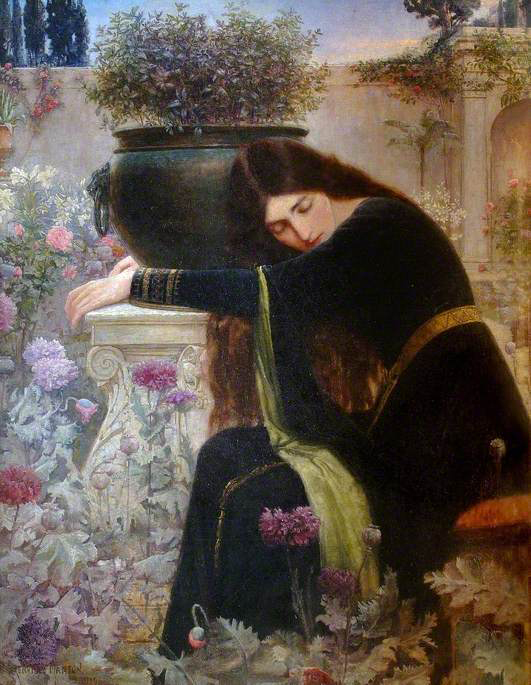
This large oil painting shows a sorrowful woman with her eyes closed, leaning her head against a large pot of the herb basil. Her arms rest loosely on the stone plinth on either side of the pot in a protective gesture. The story of Isabella The painting is based on a long narrative poem of 1818 by John Keats: Isabella, or, the Pot of Basil. The story is set in Florence, where love springs up between Isabella and Lorenzo, who is an employee of her brothers. Isabella's brothers want her to marry a rich nobleman. When they discover that Isabella and Lorenzo love each other, they entice Lorenzo out for a ride into a forest, kill him, and bury his body. On their return, they tell Isabella that Lorenzo has gone abroad on urgent business. Isabella weeps through the autumn, and often asks her brothers why Lorenzo hasn't returned. Finally, a vision appears to Isabella. It is the phantom of Lorenzo, who tells her how and where he was stabbed to death. Isabella takes her aged nurse and travels to the place described by Lorenzo's ghost. They find his grave, and uncover his body. Isabella cuts off his head, and they take it home. Isabella wraps Lorenzo's head in a silk scarf and places it in a pot, with basil planted on top. She then sits and weeps over the pot of basil. The brothers become curious. They wait for a rare moment when Isabella leaves the pot of basil, steal it, discover Lorenzo's head, and leave Florence, never to return. Isabella dies of sorrow, 'Imploring for her Basil to the last'. Keats based his poem on 'The Pot of Basil' in The Decameron, a collection of short stories by the 14th-century Florentine writer Giovanni Boccaccio. Isabella and the Pot of Basil Manton's painting shows Isabella sorrowfully embracing her pot of basil. Her dress is mediaeval in style, with gold-embroidered cuffs and a gold belt that indicate the wealth of her family. The setting is Italian: a terrace with a balustrade with classical motifs (acanthus leaves and a marble column). Some of the flowers and trees in the garden allude to lines in Keats's poem: the roses and lilies on the left-hand side of the painting, the cypress trees beyond the garden wall, and the palm tree in a corner of the garden. Paintings of Isabella Keats's Isabella was a popular subject for the Pre-Raphaelite, and for later artists influenced by them. The most famous of these paintings is Isabella and the Pot of Basil (1867) by William Holman Hunt (1827-1910), which was also the first to show Isabella embracing her pot of basil, but there were many other paintings by different artists based on the poem. Manton's version is one of the latest (1919), but still shows Pre-Raphaelite influence in its detail and symbolism. George Henry Grenville Manton (1855-1932) Manton was born in London in 1855. He married Alice Coles (who was born in Bourne End in 1867), with whom he had three children. Manton died in 1932. His widow, Mrs Alice Manton, gave Isabella and the Pot of Basil to Wycombe Museum in 1949, a year before her death in 1950 at the age of 82. At the time of the gift, Alice Manton was living in Flackwell Heath, which may explain the choice of Wycombe Museum. Manton was a trained, professional, working artist. He studied art at the Royal Academy, where he was a medallist, and was also educated in Paris. He exhibited at the Royal Academy and elsewhere, and was a member of the Society of Illustrators and the Royal Society of British Artists. Manton's paintings can be found in Watford Museum, Bushey Museum & Art Gallery, the Usher Art Gallery, Lincoln, and the Guildhall Gallery, London. Manton also worked as a book and magazine illustrator. One of Manton's most famous illustrations is The House That Jack Built, a patriotic coloured drawing in which a sailor shows a small boy how to build a house of cards. Manton painted portraits of dignitaries and wealthy people to commission. One remarkable portrait is of Miss Dorothy Brook, painted in 1918, a year before Isabella and the Pot of Basil. Miss Brook soulfully plays the violin, with cherubs in a rondo behind her head and chrysanthemums in a planter. The style is recognisably similar to Isabella and the Pot of Basil, as is the use of flowers for symbolism. There are other paintings by Manton that, like Isabella and the Pot of Basil, show a woman in emotional distress. Manton's 1914 painting In the Year of Our Lord, which refers to the 1914 German invasion of Belgium, depicts an exhausted mother sheltering under a large wayside crucifix, holding her small daughter. Manton made a speciality of heightened emotion, and had a command of dramatic gestures and emotional facial expressions. In Isabella and the Pot of Basil, he uses this skill to depict Isabella's exhausted grief. Conclusion Painted at a time when other artists were depicting the ravages of war, Manton's Isabella and the Pot of Basil can seem to refer back to an earlier, more peaceful world. However, another way of seeing this painting is as a kind of war memorial. We know that Manton was very aware of the First World War, as his 1914 painting In the Year of Our Lord shows. It could be that Manton chose to paint Isabella as a way of depicting the sorrow of all those who lost loved ones. From this viewpoint, Isabella is not just an individual woman from an old story who has suffered the loss of her beloved Lorenzo; she stands in for all who have been bereaved. Manton's painting of Isabella and the Pot of Basil is one of Wycombe Museum's most remarkable, interesting and beautiful paintings, and it has a place in the history of art as a late example of Pre-Raphaelite-influenced painting based on legend, poetry and stories. Cally Trench, June 2025 This is a summary of Isabella and the Pot of Basil by George Manton, an illustrated Art Collection talk given by Cally Trench at Wycombe Museum on 9th December 2022 and 27th April 2023. |