CALLY TRENCH
Art History Talks
Edmund John Niemann -
The High Street or the road to ruin?
Cally Trench: Art History Talks
|
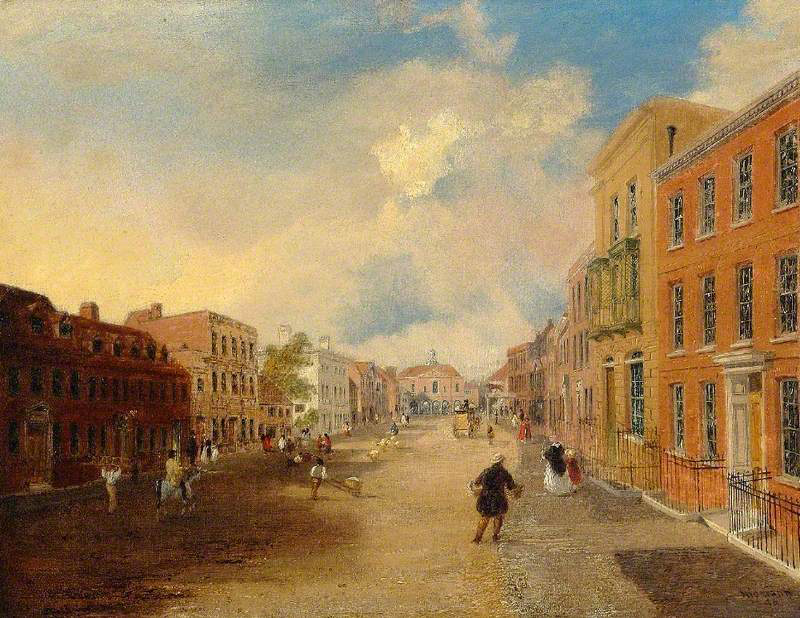
Edmund John Niemann was a prolific and accomplished painter of landscapes, including this painting of the High Street in High Wycombe in 1846. But how did he make a living - or fail to? High Street, High Wycombe (1846) is quite a small painting, about 34 by 44 cm, depicting the High Street at a time when the buildings were mainly private houses, or else inns and hotels. Niemann has included a number of people, giving us scale and adding liveliness to the scene, including a man pushing a barrow, a shepherd driving his sheep, a man carrying a ladder, a coach approaching the Red Lion hotel, and a man on a horse. The High Street - then and now Many of the buildings in the painting are still standing, including the Guildhall, which looks much the same today. The Red Lion is visible outside the hotel of that name; at street level, this now has an arcade of columns constructed in the 1970s; set back behind them are shops. The upper storeys still look much the same, and the Red Lion still is on the portico, although the portico and lion are now nearer the end of the building. The house with balconies on the right (number 17) is now a restaurant; it still has a doric pilaster on the right-hand side, but it has lost the iron railings that used to be at ground level. The house with dormer windows (number 30) at the edge of the painting on the left is still standing; it is a Grade II-listed building of flint with red brick dressings, a fine doorway with a pediment, and an elaborate eaves cornice. However, the second house with dormers is no longer standing. The tall building with a parapet just beyond the houses with dormers is a Grade II*-listed 18th-century house, and was described by Pevsner as the 'best house in the town'; this is still standing. The large white building on the left, which was called Buckingham House, is no longer standing. According Jackie Kay's A Guide to High Wycombe Based on Reminiscences by Mr. Charles W. Raffety J.P., Buckingham House was built by a Mr Daniel Hearn, a lace merchant, and the lace-workers called it 'Bobbin Castle'. The grand house with a pediment (number 39) on the left, previously called Tudor House, is still standing (Grade II*-listed), and still has its iron railings and a fine doorcase. The Falcon, which we can just make out in the painting on the left next to the Guildhall, was a coaching inn on what was then the main road from London to Oxford. This is Grade II-listed, and is still a pub. So, all in all, Edmund John Niemann's painting of High Wycombe High Street is very accurate, and painted with great delicacy and detail. A gift from Marion Disraeli
The painting was a gift to Wycombe Museum from Marion Disraeli, the widow of Coningsby Disraeli, who was the nephew and heir of Benjamin Disraeli. Marion Disraeli was a Dame of St John, an order of chivalry introduced by Queen Victoria to recognise achievements in health care and the prevention of sickness, and an OBE. After Coningsby Disraeli died in 1936, Marion Disraeli left Hughenden Manor, which was sold in 1937; the painting was given to Wycombe Museum the same year.
Edmund John Niemann Let is now turn to Edmund John Niemann. You can see a portrait of him online, painted by Edward Henry Corbould in 1852.(1) Niemann was born in 1813 in Islington, the son of Mary Louisa Niemann and her husband, John Diederich Niemann. John Niemann had come from the town of Minden in north-east Germany, which was occupied by French troops in 1806; the new Kingdom of Westphalia, which included Minden, was ruled as a client state by Napoleon's brother Jerome Bonaparte until 1810. In 1811, Napoleon moved the border so that Minden became - for a time - part of the French Empire. So, it may be that John Niemann left Minden as a refugee from the war or the occupation. John Niemann was a member of Lloyd's, the famous London insurance business. Edmund Niemann started work at Lloyd's as a clerk at the age of thirteen in 1826. Thirteen years later, in 1839, at the age of twenty-six, according his obituary in The Art Journal in 1876: 'the love of painting, which from boyhood had acquired a strong hold on him, induced him to relinquish business and follow Art as a profession'. Niemann's landscape paintings
Niemann painted landscapes, and was influenced by the Romantic Movement in art, following in the footsteps of the much more famous J.M.W. Turner and John Constable (who were 38 and 37 years older than Niemann respectively). If we look at Niemann's paintings (many of which are online), we see many of the elements of Romantic paintings. The people are shown as small and powerless in comparison with the landscape, the natural world, the sky and the weather. We may feel that the landscape depicted is 'sublime', creating in us feelings of awe, or even terror, in response to the power of the natural world, or we may appreciate the landscape as 'picturesque', to be looked at and admired like a picture. For example, Edmund John Niemann's Moonrise (2) is Turneresque in its combination of ruins, the rising moon, and the dramatic sky. Niemann's Boulter's Lock and Ray Mill House, Maidenhead, Berkshire (1842) (3) is a charming landscape on a calm day, with delicate colour in the sky; this is Romanticism as picturesque. It was painted by Niemann in 1842, when he was twenty-nine. At this time he had been married for a year to Caroline Matilda Cooper - with who he went on to have six children: three sons and three daughters, the oldest of whom, Edmund Henry, was born in 1841, the year before this painting. The marriage took place in Cookham (4), which may help explain why Niemann moved out of London. London, Maidenhead and High Wycombe Niemann makes an appearance in the London Gazette (an official government newspaper) in 1843: 'Edmund John Niemann, late of Elm-cottage, North-ton, Maidenhead, Berks, Artist. - In the Gaol of Reading.' At that time debtors were imprisoned until they had paid their creditors in full. Another entry in the London Gazette in 1843 records his arrest; this lists all his previous places of residence and his occupation at the time, although it doesn't give dates. This list shows Niemann living in Islington with his occupation given as a clerk. He then moved to Pentonville and is listed as a clerk and an artist. He maintained both professions at his next two addresses in London; so, this is not the complete break from one profession to another implied in his obituary; rather, it seems that he engaged in both professions for a time. There is then an entry for Paris, where he is 'out of business', that is unemployed. On his return to England, he went back to Islington and is listed solely as a clerk again. With the move to another address in Islington, he is listed as a clerk and an artist, and then returned to being a clerk with the next two moves - to Pentonville and Islington. Then finally he moved out to Maidenhead, where he is listed as an artist. Moves to Reading, Highgate, and then back to Maidenhead followed - as an artist in each case. However, there is no mention of High Wycombe at this stage - up to 1843. Edmund Niemann exhibited in all the most important venues of the time, including the British Institution, where he exhibited forty-five paintings between 1845 and 1867. The British Institution's record gives artists' addresses, and this tells us that, in 1845, Niemann was living at Minden Cottage - presumably named in honour of his father's home town - in Wooburn, Buckinghamshire, and, in 1846, at Mount Pleasant, High Wycombe. The Mount Pleasant address is also confirmed by the 1847 Post Office Directory, which lists: 'Niemann, Edmund John, artist & honorary secretary to the Art-Union of London, Mount Pleasant' in the High Wycombe section. Subsequently, Niemann moved back to London.Landscapes of the local area
Niemann painted many landscapes of the local area, including the Thames at Maidenhead, Henley and Cookham. The British Institution lists a painting called Cowley Spring, a watercress bed near High Wycombe, and it would be nice to know where that painting is now. Discover Bucks Museum owns a painting called High Wycombe, Buckinghamshire (5), a scene set in the beech woods above the town, which shows two men in smocks, with tree trunks, presumably headed for the furniture factories. When Niemann first exhibited at the Royal Academy (in 1844), he showed two other local scenes: a drawing, The Lime Kiln at Core's End, Wooburn, Bucks, and an oil painting, On the Thames, Near Great Marlow, which received a good review: 'the simple objects of which it is constituted compose well, with the principal being a group of trees thrown up against the evening sky. The trees are touched with decision, and left with broad effect.'(6) Other paintings by Niemann of the local area include View of the Thames at Marlow, with All Saints Church (7). In this picturesque landscape, the sky is cloudy and dramatic, and, as usual, the people are small in comparison with the trees, the expanse of landscape, and the sky. Niemann's painting View of Cliveden from the Thames (8) shows a peaceful river scene, with Cliveden high up on the hillside, to which our eyes are led by the clouds, the lines of birds and the tops of the trees. It is a very beautiful - picturesque - landscape, delicately painted in terms of detail and colour. An Art-Union review of 1845 comments that Niemann's landscapes 'principally about "the Thames", are of rare beauty and excellence', showing that Niemann's work was reviewed favourably in the 1840s. Art writer George H. Shepherd discussed Niemann's work in his book A Short History of the British School of Painting in 1891, fourteen years after Niemann's death. Shepherd described Niemann as 'a painter of a versatile and poetic genius ... akin in feeling to Gaspar [sic] Poussin ... A simple directness of aim and execution, a crisp and firm touch, and rich, if somewhat sombre, tones of colour characterize his works.' This suggests that Niemann was not only influenced by the Romantic landscapes of Turner and Constable, but also by the Baroque landscapes of some two hundred years earlier by artists such as Gaspard Poussin and Claude Lorrain; these are landscapes that are serene, harmonious and balanced, often forming the backdrop to scenes from myth, religion or history. The 1840s also saw Niemann trying to make money through the sale of engravings, including one of The High Street, High Wycombe, engraved by W. Faithorn. There also exist an engraving of All Saints' Church, also engraved by W. Faithorn, and one of the Guildhall, engraved by Newman and Barclay. There must have been original paintings in both cases from which the engravers worked, but we do not know where these are now. Print-selling in the 19th century could be a very lucrative business, but it was also highly risky, and even series of prints based on paintings by Turner and Constable did not make a profit. It is likely that Niemann's engraving ventures did not make money. Exhibiting
Niemann exhibited widely; he is listed as exhibiting 114 works in total between 1844 and 1872: 29 paintings at the Royal Academy, 45 at the British Institution, as we have already seen, and 40 at Suffolk Street, which was the venue of the Society of British Artists.(9) Niemann was also one of the trustees and honorary secretary of the Free Exhibition, which was held initially in a gallery at Hyde Park Corner, and which later became the National Institution of Fine Arts. Niemann's paintings in the first Free Exhibition received an excellent - if somewhat surprised - review: 'The pictures of this artist appear here with qualities we have never before recognised in them; that is, they are in everything so much superior to all works which have been hitherto exhibited under this name, that it is difficult to conceive how so sudden an approach could be made to the best and rarest expressions of landscape art. The material of this picture - 'The Thames at Maidenhead' - is extremely slight; everybody knows the scenery of the Thames; but it is dealt with in a manner so exquisitely tender, and so beautifully contributive to the effect proposed, as to challenge comparison with works ranked as the best in its own particular class.' Niemann also exhibited at the Royal Scottish Academy, the Royal Institute, the Glasgow Institute, the Paris Salon, the Liverpool Academy of Arts, and the Manchester Academy of Fine Arts. Travelling Niemann travelled a lot to paint his landscapes, including to Whitby and Richmond in Yorkshire, Stonehenge, Norwich, Warwick, Newcastle, Bristol, Derbyshire, and to Scotland, Wales and Ireland. His painting Town and Vale of Ffestiniog (10) is a very accomplished painting; the colours are delicate in parts, strong in others, and the gradation of colours across the sky is very beautiful. This is a Romantic landscape that inspires wonder. In the 1850s, Niemann also visited Ireland. His dramatic landscape Black Castle, Wicklow (1854)(11) is another example of the sublime: we have many of the usual components - a dramatic sky, rocks, trees, a distant view, and a ruined castle on a mountain top. Debt In the same year as he painted Black Castle, Wicklow, 1854, Edmund John Niemann put in another appearance in The London Gazette; he was bankrupt, and had arranged to pay his creditors one shilling and one penny three farthings in the pound. This time he wasn't arrested or sent to gaol, because the Bankrupt Law Consolidation Act of 1849 permitted voluntary bankruptcy, allowing debtors to settle with their creditors and to receive a 'discharge' from their indebtedness. Now you may be wondering why Niemann had a debt problem, but the real question is how anyone made a living out of landscape painting. We have already seen how engravings could be a financial disaster, but what about sales of actual paintings? Turner did make a good living. In 1802, at the age of only 27, he became a full member of the Royal Academy, and this will have improved his reputation and his sales. Turner went on numerous painting tours and produced an enormous quantity of work. Most importantly, Turner had wealthy and often aristocratic patrons. Unlike Turner, Niemann never became a member of the Royal Academy. In addition, his output was nothing like Turner's. Niemann did, however, have some patrons who bought his work. All five of his paintings shown in the Academy at Manchester in 1848 were sold shortly after the opening of the exhibition.(12) And in 1878, two years after Niemann's death, fifty-five of his paintings were shown in an exhibition in Nottingham Castle; the catalogue for this exhibition lists the owners that lent the work in their possession. In 1882, six years after Niemann's death, seven paintings by Niemann were included in an exhibition called The Loan Picture Exhibition in Aid of the Wycombe Literary and Scientific Institute. This was held in the 'well-lighted and spacious board schools', now Hamilton Academy. A review in the South Bucks Free Press was enthusiastic about Niemann's paintings: ' ... all gems of their kind, exhibiting this once local Artist's great power in masses of foliage, wooded ravines and in atmospheric treatment.' All seven paintings were lent by a Mr Cooper of Reading.(13) Local historian Sally Scagell noticed that this is the same surname as the maiden name of Niemann's wife (Caroline Matilda Cooper), so it may well be that this collector was an in-law of Niemann's.(14) So, Niemann clearly did have collectors - but simply not on the scale or with the wealth of Turner's often aristocratic patrons. Niemann put in several more appearances in the London Gazette: in 1861, he was bankrupt again and settling with his creditors at a rate of five and a half (old) pence in the pound; in 1863, he was bankrupt, this time having agreed to settle his debts in full over a period of years; in 1866, Niemann was 'adjudged bankrupt' again; and unfortunately, Niemann was bankrupt once again in 1871. Dramatic and beautiful landscapes Niemann continued to paint landscapes through the 1850s and 1860s, including a dramatic and beautiful view of Whitby Harbour (1859) (15), and one of his best paintings, Deer Stalking in the Highlands, a Quiet Shot (1860) (16), which was described by art writer George H. Shepherd: '... it alone is sufficient to place him in the highest rank of modern painters. Enclosing a valley strewn with hugh [sic - huge?] rocks like the ruins of a shattered world, are lofty mountains; their proud crests look down upon a rugged gorge extending for miles across the picture; a gleam of bright sunshine illumines the last and most distant crag, elsewhere the clouds descend and veil in gloom the majestic peaks of giant hills.'(17) Another impressive painting by Niemann is Whitby, North Yorkshire, from the Sea (1862) (18), where we are very aware of the danger to the small boats confronted with the power of the sea. Niemann's two powerful paintings of Filey Brigg, North Yorkshire from the late 1860s (19)(20) depict ships in danger off this dangerous ridge of rocks off the Yorkshire coast. These are surely two of Niemann's best paintings; we feel awe at the natural world and anxiety for the ship and sailors who are liable to be overwhelmed by the uncontrollable power of sea and storm. George H. Shepherd argues that some of Niemann's 'grand storm pieces ... are not unworthy of being hung besides Turner's finest efforts'.(21) Last years and death Edmund John Niemann's last painting shown at the Royal Academy was in 1872, when he was 59; it was a view of Scarborough.(22) He died in 1876 at his home in Brixton of 'apoplexy'. Niemann Junior Niemann's son, Edmund Henry Niemann (1841-1910), studied landscape painting with his father, whose style he imitated, and it can be hard to distinguish their work except on the basis of date. Conclusion George H. Shepherd argued that: 'The most striking characteristic of Niemann's genius was versatility: not the fickleness of incapacity, but the many-sidedness of a luxuriant and vigorous imagination, capable of enjoying and depicting every phase of nature.' Niemann was equally capable of picturesque landscapes of the river, storms at sea, castles on mountain tops, untamed landscapes, and, as with 'High Street, High Wycombe', a picturesque but accurate view along a high street. George H. Shepherd goes on to say that: 'The genius of Niemann ... failed to receive academic recognition; but happily the judgment of that tribunal is not definitive ... The claims of Niemann can no longer be disregarded; he too has appealed to posterity; we believe the verdict will be given in his favour.'(23) Let us give the final word about Edmund John Niemann to James Dafforne in 1877: 'examples of his work would adorn any well-chosen gallery where pure landscape is admitted.'(24) And indeed, this painting of High Wycombe's High Street is an adornment to the art gallery here. Cally Trench, May 2026 This is a summary of Edmund John Niemann: The High Street or the road to ruin?, an illustrated Art Collection talk given by Cally Trench at Wycombe Museum on 1st February and 19th March 2026. Notes(1) Edward Henry Corbould (1815-1905). Portrait of Edmund John Niemann (1852). Oil on canvas, H 35.2 cm W 29.2 cm. Nottingham Castle Ducal Mansion. Public domain via Wikimedia Commons. https://commons.wikimedia.org/wiki/File:
|